DAX – Benchmark and Barometer for the German Stock Market

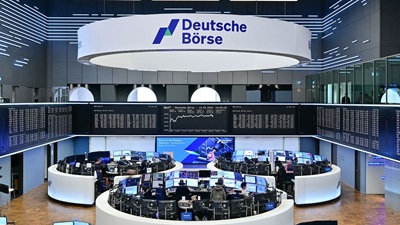
Trading floor
The DAX® index, the best-known German stock market barometer, has measured the performance of the 40 largest companies on the German stock market for over 35 years. It represents around 80 percent of the market capitalization of listed stock corporations in Germany.

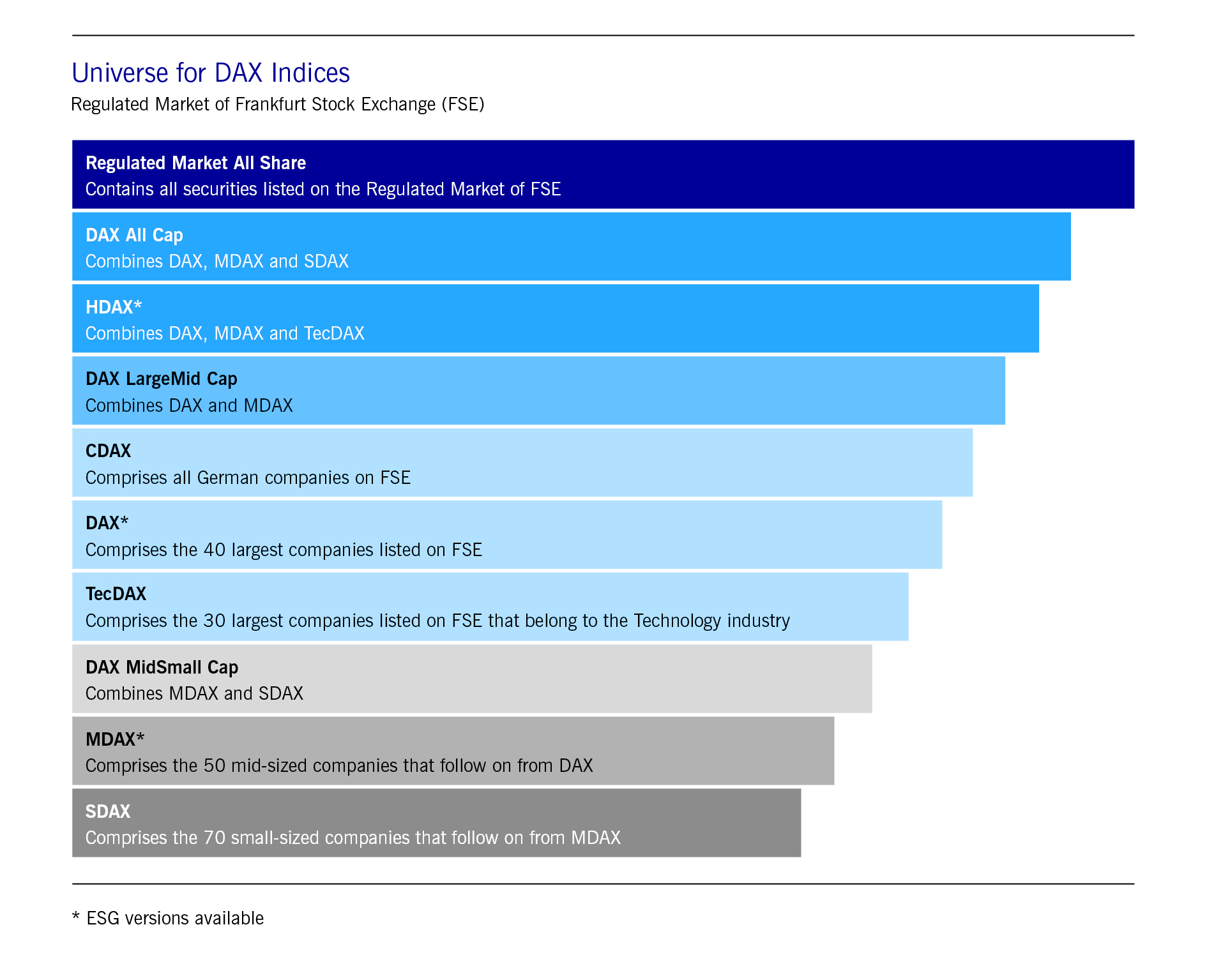
The DAX index family

DAX is a trademark of ISS STOXX Index GmbH, which belongs to Deutsche Börse Group. The DAX index is the German equity benchmark and serves as the underlying for a large number of products such as ETFs, listed derivatives and structured products. As a selection index, it tracks the largest companies listed on Frankfurter Wertpapierbörse (FWB®, the Frankfurt Stock Exchange).


The DAX index family comprises further indices such as the MDAX®, which tracks the 50 largest companies that follow the DAX index, the SDAX® index, with the 70 next biggest companies after the MDAX index, and TecDAX®, with a focus on technology companies.


DAX index family
The composition of the indices is reviewed quarterly. There is a clear and transparent set of rules regarding admission and removal of companies to or from the indices (see Guide Equity Indices). Since September 2016, the process for selecting companies in all indices has been purely quantitative as well as completely automated, and aligned with the existing DAX index rules.


These rules ensure that the indices maintain a high degree of tradability, replicability and continuity. The automated process leads to further improvement in the transparency of the index rules and visibility of changes and enables an objective and fact-based process for determining the composition of the equity indices.


The indices are reviewed on the third trading day of the review month. Changes take effect on the Monday after the third Friday in the review month.



Selection criteria

Companies qualify for admission to the DAX index mainly based on their free-float market capitalization on a specific date (last trading day of a month). This figure is calculated using the volume-weighted average price (VWAP) of the last 20 trading days and the free float as of the selection list cut-off.


STOXX publishes its monthly selection lists, which serve as a basis for decision-making in index reviews. For a company to be included in a ranking list it needs to fulfil the following criteria:


  • an existing listing on the Regulated Market of the Frankfurt Stock Exchange
  • shares must have a minimum free float of ten percent
  • it must have its legal domicile in the EU/EFTA or operative headquarters in Germany
  • it must have positive EBITDA for the two most recent fiscal years to be included in the DAX 
  • it must continuously trade on Xetra®
  • it must fulfill minimum liquidity requirements
  • it must have a minimum period since first listing: at least 30 trading days
  • it must submit annual financial statements, half-yearly reports and quarterly figures
  • it must adhere to certain provisions relating to audit committees in the German Corporate Governance Code.

The rules

DAX is subject to regular reviews in March and September. All indices are also reviewed in the remaining quarter-end months (June and December) based on the “Fast Entry” and “Fast Exit” rules, with higher inclusion and exclusion hurdles than for the regular reviews. These index adjustments are intended to take into account significant changes on the ranking list. These may arise, for example due to companies that no longer have the necessary size (free float market capitalization), for example due to large changes in the free float or large drops in price.


Overview of rules for index composition:


  • Fast Exit: A company is excluded from the index if it has a rank worse than 60 in DAX, 110 in MDAX, 180 in SDAX, and 45 in TecDAX based on free-float market capitalization. It is replaced by the company with the highest rank that is not part of the index.
  • Fast Entry: A company is included in the index if it has a rank equal or better than 33 in DAX, 83 in MDAX, 153 in SDAX and 25 in TecDAX based on free-float market capitalization. It replaces the lowest-ranked company in the index.
  • Regular Exit: A company can be excluded from the index if it has a rank worse than 53 in DAX, 103 in MDAX, 173 in SDAX, and 40 in TecDAX, provided that there is a company that has a rank equal or better than 47 in DAX, 97 in MDAX, 167 in SDAX and 35 TecDAX for both criteria. If no alternate candidate can be determined, there is no change.
  • Regular Entry: A company can be included in the index if it has a rank equal or better than 40 in DAX, 90 in MDAX, 160 in SDAX and 30 in TecDAX for both criteria, provided that there is a company that has a rank worse than 47 in DAX, 97 in MDAX, 167 in SDAX and 35 in TecDAX. If no alternate candidate can be determined, there is no change.

Resulting adjustments to the indices are announced quarterly in March, June, September and December; however, the indices with their new composition are not calculated until the rebalancing dates around two weeks after the announcement of adjustments. More precisely, the indices are rebalanced on the Monday following the third Friday in March, June, September and December, as the DAX futures expire on those particular Fridays. This ensures that the new index composition is also reflected in the DAX futures, enabling market participants to prepare for impending changes and adjust their portfolios as necessary. The new composition not only involves adding new companies to the index but also updating relevant key figures in the indices on a quarterly basis and limiting the weighting to a maximum of fifteen percent to prevent heavyweights from dominating.


If a company becomes insolvent, is taken over by another company or its free float drops to below ten percent, an extraordinary replacement may also be undertaken before the set dates.


The rules

Announcements on composition reviews of the DAX indices can be found at stoxx.com.


Continuous trading on Xetra starts at 09:00. The calculation of the DAX begins as soon as the opening prices for all index components have been received on Xetra, or at 09:06 at the latest. The DAX index is calculated every second on the basis of Xetra prices. The last DAX index tick is disseminated at 18:00.

All selection indices are calculated as price indices (tracking pure price performance), performance indices (fully reinvesting all dividends) and net return indices (reinvesting the net dividend). DAX is usually considered a performance index.